Showing posts with label Kyushu University. Show all posts

Wednesday, January 11, 2012

American Fighter Plane Crashes into Kyushu University!

A couple of years ago I had a conversation with Ena`s uncle about Kyushu University. He had been a student here in the 1960s, which I thought was kind of an interesting coincidence.

The fact that Hakozaki campus is located right under the approach to Fukuoka airport at one point made its way into the conversation. Boeing 747s and other aircraft are only a couple hundred metres overhead when they fly above the campus, which makes it quite noisy.

While talking about that he mentioned something that piqued my interest. During his days as a student a plane had actually crashed on campus. A military plane, an F4 Phantom, flew right into a building.

I was interested in learning more about the incident, but ended up forgetting about it until a couple of days ago when I bought this book:

Kyushu University celebrated its 100th anniversary last year and the published this photographic history of the University. I thought it was kind of neat so I bought a copy at the Coop.

The book has a couple of pages devoted to the crash, which it turns out was a pretty big event in the University`s history. It occurred on June 2, 1968 when the Phantom crashed into this building:
Both of the pilots ejected safely and nobody was in the building at the time so fortunately nobody was hurt in the incident.

I did a bit of further research online about it. There isn`t anything in English, but the Japanese Wikipedia has an article about it here. There is a bit of a Cold War background to the incident. In January of 1968 North Korea seized an American spy ship, the USS Pueblo along with her crew. As part of their response to this incident the US moved a number of its aircraft, including the one that crashed into campus, from Okinawa to Fukuoka (which is much closer to North Korea and the Sea of Japan).

Anyway, after reading all of this I became a bit curious about where exactly on campus this plane had crashed. The building it hit, which was under construction at the time, was called the 九州大学大型計算機センター. This roughly translates as Kyushu University Large Model Computing Device Center Building. I looked at the campus map but couldn`t find anything of that name.

The picture of the building itself wasn`t very helpful either. It just looks like a big ugly concrete box, which is what ninety percent of the buildings on campus look like:
The above picture did at least have some other buildings in the photo to work with though. I decided to bring it with me and zip around campus on my bike during my lunch break yesterday to try to find them.
It actually didn`t take me that long. The building in the upper right hand corner of the photo is the architecture building here:
I`ve always found it amusing that the architecture faculty of one of Japan`s top national universities is housed in perhaps the ugliest building ever created by human hands, but that is another story.

Anyway, the building visible just to the left of the crash site is this one here:
Identifying the two of them allowed me to triangulate the position of the crash site as being this building here:
This is the Research Institute for Information Technology. They must have renamed it since the crash. They also seem to have expanded it as it looks bigger than the building under construction in the photo.

Anyway, forty four years ago this building actually had the tail end of an F4 Phantom sticking out of it. I think it looked better with the wreckage still in it, and as it turns out so did a lot of students at the time, albeit for different reasons. For me the charm mainly lay in the fact that you see so few university buildings with F4 tail fins sticking out the side that it would be just kind of a nice thing to have preserved.

For the students back then though it was all political. Thousands of them took to the streets in the days after the incident to protest against all that stuff that used to get the young folks riled up back in the 60s. One of their demands was that the wreckage be left in place. They wanted this to serve as an anti-war symbol. That really doesn`t make much sense seeing as this event didn`t occur in a war and nobody was actually hurt in the incident. It is not exactly the sort of thing that stirs people`s pashions like the monuments in Hiroshima or Nagasaki do. Perhaps the commemorative plaque would have read:

On this spot in 1968 an American warplane`s senseless action led to the loss over 100 hours worth of drywall work, 40 hours of electrical installation work and an unknown quantity of linoleum. Lest we forget.

At any rate, barricades went up and they were able to actually prevent anyone from removing the wreckage for about 6 months. Eventually some workers snuck in at night with a bulldozer and yanked it out when everybody was....doing whatever radical 60s students in Japan did at night.

Anyway, I thought this was rather neat. I love my new Kyushu University picture book, its full of interesting stuff like this. If only I had the time to explore them all.

UPDATE

Just found out a little more information about the crash from, of all places, a website that tracks ejections from jets. The Japanese sources (including my beloved Kyudai picture book) didn`t have any information about who was actually flying the aircraft or what they were doing, so that site was able to fill in a couple of blanks in the story. It seems that the pilots, Major E.E. Johnson and Lt. Col. R.F. Crutchlow, were undergoing night time take off and landing training when the F4 caught fire on approach to Fukuoka airport. They seem to have ejected just seconds before it hit (their parachutes landed just a few metres from the crash site), must have been quite the close call for them.

Tuesday, February 22, 2011

The Latter Days of an Idiosyncratic Library

I think the most fascinating part of Hakozaki Campus is one of its most under-rated: the Humanities and Social Sciences library.

I have been to a lot of libraries in a lot of places, but our little library (one of several on campus) is like none I've seen anywhere else. It is a riddle wrapped in a mystery, inside an enigma. As a person who enjoys wandering aisles of old books looking for inspiration I fell in love with the place at first glance.

And, seeing as how the library rules do not prohibit photography, I thought I would take a walk through its aisles with camera in hand. Hence this post.
If I had to suggest one image that would conjure up the experience of visiting the library in your minds, it would be this one:
That is the closing scene from Raiders of the Lost Ark. It is the giant warehouse where the government puts stuff that it wants to lose. The impression one gets is that by placing the Ark there, the government is assuring it will never be found again. For present purposes we can ignore the fact that the fourth film ruined this image by establishing that it was, in fact, possible to find something that had been placed in this warehouse.

Our library has a certain element of this going for it - it can be very difficult to find things in it even if you are intimately familiar with each of its floors. It also kind of looks like the warehouse a bit, with stacks of boxes of its own:
It is really a lot more than that though. It is a facility that has had to deal with the multiple problems of overcrowding, antiquated facilities and problems unique to the storage of Japanese reading material that is different from problems faced by Western libraries. The valiant efforts of the library staff to overcome these problems lend the place a fascinating charm that no other library I've ever been to can offer.

In a few years, this library along with the rest of campus will be relegated to the dustbins of history. The new Ito campus will absorb the staff and resources of the library, and probably incorporate them in a much more logical, user-friendly way than the current library is even remotely capable of.

This will probably have a lot of benefits for future researchers, who won't be anywhere near as bewildered by the experience of looking for a book as what the current set-up elicits. The sentimental and somewhat irrational side of me, which is responsible for a lot of these types of posts on this blog, will miss this library when it is gone though. When the campus moves, the many idiosyncrasies of today's library brought about by its functional shortcomings will be lost forever. It is to those wonderful bits that this post is dedicated.

The most obvious and least interesting of these to those using the law library is the simple lack of shelf space. This necessitates the use of makeshift "shelves" on the floor:
The law library is actually one of the least interesting parts of the library. It is relatively well-organized and user friendly. The truly fascinating parts of the library are located in the literature section.

The first floor of said section is relatively normal. Just a library like any other. But the further you move in, the more you notice the effects of overcrowding. In some places, this is evidenced by shelves placed insanely close together:
In others, it is illustrated by the use of make-shift means of storage for odd-sized books. The big Chinese-English dictionary for instance is kept on a chair:
Lack of shelf space also leads to the unconventional use of other storage media. Empty orange boxes are to be found everywhere housing the overflow:
Someone must really like oranges.

Other favorites include wicker baskets:
And paper shopping bags:
I have to stress that these are all on library shelves in the regular stacks and not in some inaccessible storage room or anything. This is how things are actually presented to us users of the library.

Anyway, the most interesting part of the literature library is on the top floor, where they store some truly amazing stuff. Shelf upon shelf of invaluable old works:
Different from libraries in North America, older works are sometimes found in scroll form, which are boxed and in a dark, dusty and mysterious section of their own:
A lot of the older works not in scroll form have lovely wooden boxes of their own:
As the above photo attests, these present a problem to libraries which are designed to hold books of a certain dimension. They just don't fit into the shelving system, so they are to be found at random locations on the floor and on tables here and there wherever they could be fit in throughout the library.

There are a few other random, recurring themes in the library. One is the presence of the old card catalogs, which the library hasn't figured out what to do with and has dispersed them to various corners of the stacks out of the way, awaiting whatever fate has in store for them:
Other outdated tools of the library trade are also to be found squirreled away in various nooks and crannies: Bundles of old Korean newspapers are - for whatever reason - also to be found here and there:
As are rotary-dial phones:
And carts pressed into service as make-shift shelves:
A lot of this of course contributes to the difficulty in finding things on occasion. It would be very difficult to devise a cataloging system that could, in alpha-numeric code, convey the fact that the Oregon Historical Quarterly is to be found on the 3rd floor, between two shelves on a pile of boxes, next to an empty box of tape:
Actually, I have to admit that the library is nowhere near as haphazardly organized as these photos make it out. A lot of stuff is logically ordered and properly shelved. But these odd bits really do give it an atmosphere unlike most libraries I've been to. They make it an interesting place to go for a stroll...well, again that is only "interesting" if you are a type like me who finds stuff like this interesting.

Thursday, November 18, 2010

Hakozaki Campus's Wall of Mystery

I was riding my bike across campus a few weeks ago when the above sight caught my eye.

Yup, two ugly, ugly buildings and a parking lot. Not much of a sight. What caught my eye was the wall on the larger building on the right. There is a lot of graffiti on the top two sections of it:
You'll note that someone has expended a lot of effort defacing the graffiti. What I find quite funny is that they obviously had two different people cleaning each section, and each of the cleaners used a different strategy to remove it. These different strategies reflect completely different philosophies about the underlying purpose of graffiti removal.

On the top section, the person basically contented him/herself by defacing the graffiti enough to make it completely illegible. The black ink remains, but so long as you can't actually read what was written, that is good enough.

On the lower section, the person made some effort to cover up the graffiti by using paint that almost matched the color of the wall. Restoring the aesthetic appearance of the wall (such as it is) was the over-riding concern.

What I really like about the person who cleaned up the lower section is that they adopted an extreme minimalist approach. They exactingly painted over only the graffiti and did not get paint onto any part of the wall that wasn't defaced. Basically, they just traced over the graffiti in a different color of paint.

This was very useful because thanks to the fact that the paint they used isn't quite the same as that on the underlying wall, it is still possible to read what was written on the lower section. It says this:

解放教育構造

Which crudely translates into "Free the structure of education". Or something like that.

I pointed this out to my colleague Fabio one day and we stood in front of the wall for a few minutes pondering the meaning of it. A professor that we knew happened to pass by and we asked if she knew what it was about. She said that during the 1960s there had been a number of student protests during which activists had occupied some of the buildings and this was likely something they had written during that time. Like us she couldn't read the graffiti on the top section, so its meaning has been lost to the ages.

Fabio pointed out that the graffiti isn't the only whimsical thing about this wall. It has these two rusted out signs posted prominently on the section below the lower graffiti one:
It says "Please do not throw balls against this wall." Of course if you look at the location of the wall, it is in a narrow alley wholly un-conducive to the throwing of balls:
The obvious explanation is that the building on the right in the above photo was built sometime after the one on the left and that during the period before its construction this must have been a popular place for students to play some sort of ball game that must have seriously annoyed the professor who occupied the office adjacent to that external wall. I love the fact that those signs are still up there so long after they stopped serving any practical purpose.

The whimsy doesn't quite end there though. This is also the sight of one of those "staircases to nowhere" that so fascinate me:
Unlike the "don't throw balls" sign, the existence of this stairway defies easy explanation. To be fair, there is a door on the left just out of sight of this shot, but it has its own section of dedicated stairway. Why did they build these steps leading straight into a concrete wall? Was it part of some government building program designed to soak up a glut of metal staircases on the market at the time? Was it some comical mis-reading of the blue prints that resulted in one side of the building getting too much staircase and another not enough?

I suppose I could ask around and find out, but I rather like not knowing. It adds to the mystery and appeal of this wall. The explanation would only end up being mundane and boring. Sometimes too much knowledge ruins things. Ignorance can be bliss.

Sunday, October 31, 2010

UVic Fukuoka fun days

My old law school back in Canada - UVic - has a close relationship with Kyudai. One of the effects of this is that we are treated to the occasional visit by UVic law profs, giving me and the other UVic alumni here the chance to play host and show our distinguished visitors around Fukuoka.

In 2008 shortly after my own arrival Mark, a UVic prof specializing in a number of fields, arrived to teach a course in securities regulation. Unfortunately I was the only UVic grad present during his time here so our hospitality was limited to a lunch at Gusto, a "family restaurant" of (I'm shamed to admit) dubious quality. He displayed admirable graciousness throughout the meal in not pointing that fact out:In July of this year we were graced by a visit from Donna, the Dean of UVic law. With a whole team of UVic grads present at that time - Anita, Andy and I - we were able to show her a bit more Fukuoka hospitality. We took her around Dazaifu and had a really nice time there:
Last week we were visited by Martha, UVic's tax and EU law specialist, who had come to give a lecture on international taxation at Kyudai. The lineup of UVic alumni had changed somewhat with Andy having gone back to Canada and Brett having arrived shortly thereafter. After being treated to dinner on the first day of her visit, we took her to the Fukuoka Museum of Modern Asian art. Brett would probably like me to make it clear that he is pointing not to himself but to the "UVIC" on his shirt in this photo:
We had gone to this museum during Donna's visit as well and I think we are developing something of a tradition of taking UVic people there. Its a nice museum with some traditional "Modern" art:
And the more contemporary head-scratching entries:
After the museum we bade Martha farewell and Brett headed to a department store called "The Loft" where Ena and I later crossed paths with him. He was in the middle of some Halloween costume purchasing, so we followed him around a bit to see what he got. The racks of gag nose-hair caught my eye:
Ena and I did a bit of wandering around on our own, pausing to ponder the imaginative world of Japanese stuffed-animal design:
After that we headed off in search of dinner. The intimate lights of a hidden alleyway beckoned:
Lanterns nestled snugly beneath a canopy of lit offices in the towers beyond:
We settled into an Indian restaurant to dine on the "Suraj" set:
Served under the warm glow of ancient chandeliers:
A fitting end to yet another UVic Fukuoka fun day.

Sunday, August 29, 2010

Kyudai Hakozaki: The Elegant Decay of a Dying Campus

The sound of the Gion Shoja bells echoes the impermanence of all things; the color of the sala flowers reveals the truth that the prosperous must decline. The proud do not endure, they are like a dream on a spring night; the mighty fall at last, they are as dust before the wind.

- Opening passage of the Heike Monogatari (13th century military romance. Translated by Helen Craig McCullough)

In the 18th century European romantic artists had a bit of a thing for ancient ruins. They represented decay and the notion that the accomplishments of man were transient and destined to ultimately be swallowed up by nature. I remember reading once that one Romantic painter (I forget who) was virulently opposed to the preservation of the ruins of Heidelberg castle in Germany. He found the process of their decay to be much more attractive than the actual ruins themselves. Thankfully saner heads prevailed and the ruins of Heidelberg castle were passed down to the present generation.

In Japan, as the above quoted portion of the Heiki Monogatari indicates, a similar fascination with the impermanence of life and human achievement has long permeated the nation's artistic and aesthetic traditions.

In its modern form this fascination manifests itself in the hobby referred to as "Haikyo", which roughly translates as "abandoned buildings". The combination of a declining population, urbanization (and the consequent de-population of rural areas) and economic stagnation over the past 20 years have created a vast number of abandoned ruins dotting the country and slowly being reclaimed by nature. Haikyo enthusiasts seek out, explore and photograph these ruins.

By "ruins" I should note that I don't mean ancient ruins, but the ruins of mostly 20th century buildings. Abandoned hotels and theme parks are all over the place here and their slow decay has a certain charm to it. The "mother" of all modern ruins is Gunkanshima ("battleship island") an island that once housed about 5,000 coal miners but was completely abandoned in the 1970s. Recent interest has led to efforts to have the island declared a UNESCO site. This guy here made a surreptitious visit to the island (its mostly off-limits due to the danger of the crumbling buildings) and posted his rather interesting story with some incredible pictures on his blog. I should probably stress that while that guy committed acts of trespass (which most Haikyo explorers do), I am more of a Haikyo "poser" and only photograph buildings from the street. I like looking at them but am not willing to break any laws to do so. I don't condone trespass but I have to admit, that guy's blog is really interesting.

As I've mentioned in earlier posts, Kyushu University's Hakozaki Campus, where I study, is currently in the long process of shutting down and moving to a newly-constructed campus on the Ito peninsula west of Fukuoka. This is part of a long plan which originated decades ago but has been plagued by all sorts of problems leading to huge delays. An archeological discovery at the site of the new campus required excavations that led to significant delays in construction. Then a million and one problems with the financing led to even more delays. I won't get into the details (I hear contradictory stories all the time about this and am not sure which is correct) but suffice it to say if things had gone as originally planned Hakozaki Campus would have been shut down and sold off years before I even arrived here. I'm thankful that things didn't go according to plan.

Despite the delays a number of departments have closed in recent years and made the move to Ito campus. As a result a large number of buildings on Hakozaki Campus now sit shuttered and abandoned. Today being a sunny Sunday and me being in an artistic mood I set out with my camera to record Hakozaki Campus's slow reversion to nature.

I entered through the Matsubara-Mon gate, which is on the opposite side of campus from where I have my office. I cycled down a dirt path to the left of the gate and came across an old tennis court:
It was over-run with weeds and looked like nobody had played a set there in years. The clubhouse next to it looked like a frozen picture in time with some abandoned umbrellas and slippers scattered about while the vines grew all over the place:
Next to the clubhouse a fan rests in a pile of junk:
As does the court's old clock:
Next to the Tennis Court stand a number of abandoned buildings with corrugated metal siding that have been almost completely swallowed up by vegetation:

According to an old campus map I have (these buildings aren't identified on the new maps) high current electrical experiments used to be performed in them. I find it funny that now, years after they have been closed and been swallowed up by this greenery, these buildings are probably much more attractive than they ever were when in use.

Not all the abandoned buildings have been swallowed up like that though. This cute administrative building is boarded up and slowly decaying (bits of masonry have fallen off here and there) but the vines and weeds have been kept at bay:
There is something painfully lonely about the sight of bulletin boards that have seen their last handbill:
The glass on this one is long gone. I tried to read the remnants of the handbills to find out how long they had been there but couldn't find any dates:
The area around the tennis courts near Matsubara-Mon have a lot of abandoned buildings on alleyways that are covered in greenery and kind of nice to explore. My next stop though was the absolute masterpiece of Hakozaki Campus's ruins: the old Chemistry and Engineering building:
This is actually a historically important building. It was built in 1925 and designed by a well-known architect named Kurada. Its one of the oldest concrete buildings in Fukuoka and was one of the most elegant buildings in town in its day. Even with years of neglect and the encroachment of nature the uniqueness of its design and its general attractiveness are still plainly visible.
I'm not sure how long it has sat abandoned. I have a book about Fukuoka published in 1993 which has a picture of it and makes no mention of it being closed so it was likely still being used then. The size of this tree growing out of its foundation however suggests that it has likely been closed since not long after that, maybe since the late 90s:
The entrance to this stairway was probably one of the nicest in all of Kyushu back in 1925:
Its hard to even tell that there is a staircase here anymore:
The west side of the building has a large chimney:
This is the front of the building, it is the first site you see when entering the campus from the main gate. Once upon a time it would have offered a warm welcome to visitors but now....:
Moving on I head over towards the former site of the engineering faculty, which has alley after alley of abandoned buildings:
This one is probably the most impressive, I think it might be pre-war as well judging from the architecture but could be mistaken:
Some old signs sit with no one to read them:
Some of the buildings here weren't particularly attractive, designed in the "1960's era Soviet Block proletarian dreary" style:
No bikes parked here anymore:
I came across one of the "hidden gems" of Hakozaki here, this really nice red-brick building (red bricks are very rare in Japan):
It had a nice old tiled roof:
And was quite long:
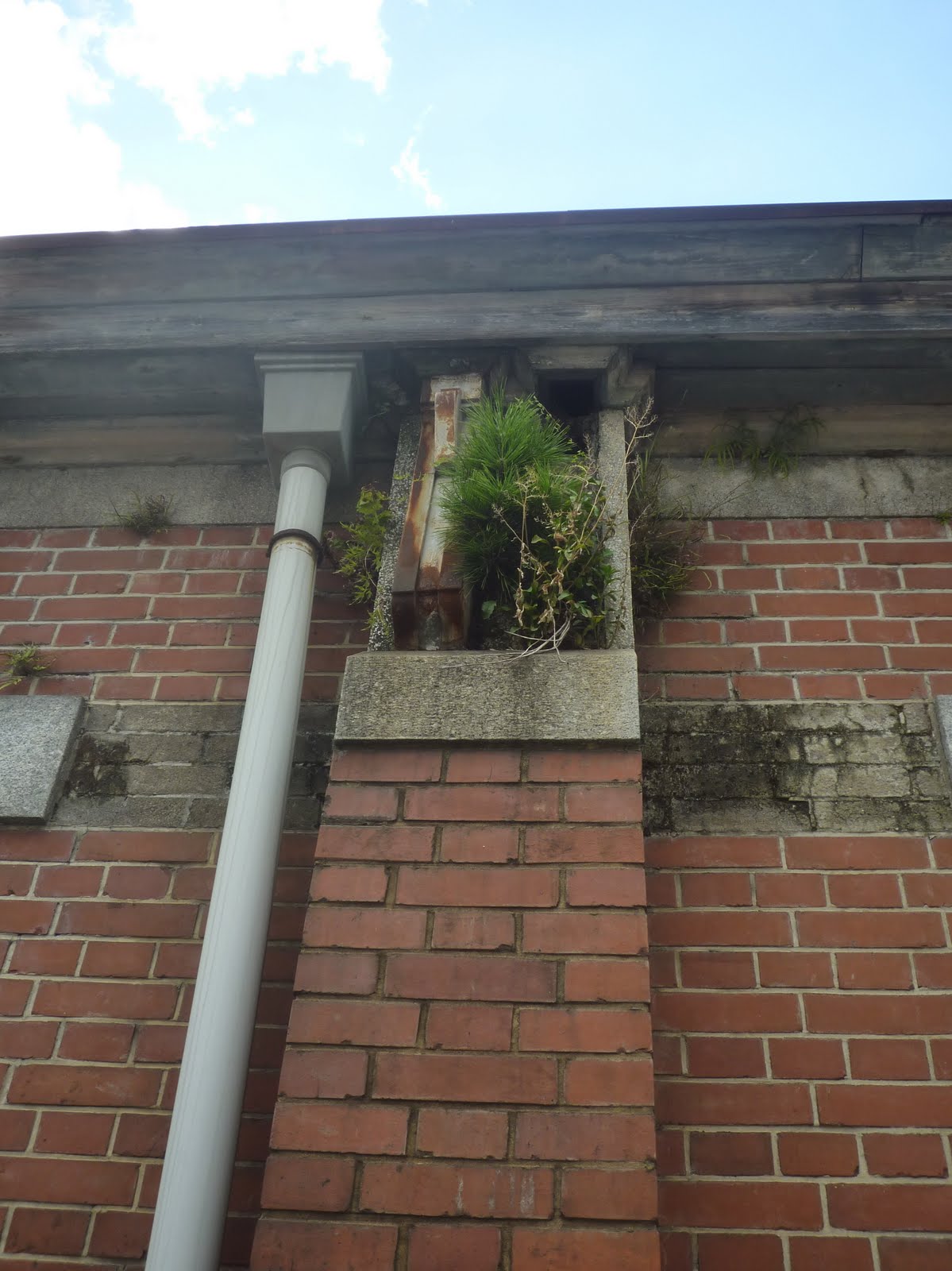
The real charm lay in the details though. Like this little pine tree growing out of the top of one of the columns:
The ornament that the pine tree had pushed out lay on the ground beneath, propped up against the side of the building:
I also liked this window. Over the years different panes had been broken and replaced with new ones that didn't quite match the old:
After that I came to this mysterious building. It looked like a small shack of normal proportions at first:
Yet closer inspection revealed it to be a capsule-shaped concrete cylinder, barely visible beneath the vegetation:

Must have been used for some kind of experiments, but what kind I have no idea.

Nearby was this "signpost graveyard":
Doors that will never be opened again have a certain poignancy about them:
My eye was next drawn to this tower looming in the distance:
I made my way over to check it out, passing by some more smaller abandoned buildings along the way:
The wood slats were falling off of this one:
The building with the tower was (I believe, the signs had all been removed) formerly an aerospace engineering building:
An abandoned tower has a certain charm to it, the way it looms over everything, the top part just barely tall enough to have avoided being swallowed up by the encroaching wildnerness:
Its interesting to think of what this courtyard would have looked like 30 years ago with tons of students milling about:
The vines are pretty thick on this one:
The other side of the building was a bit less covered in them:
There was a long building with a corrugated roof that ran next to the courtyard:
Next stop on my tour was the agriculture faculty. The agriculture faculty hasn't moved yet so most of its buildings are still in use, except this one:
There was some sort of mini-train car in front of it, I have no idea what it was used for:
I was kind of surprised to find that they have an abandoned tennis court also:
This isn't actually an abandoned thing, but I think these are kind of amusing. These are the emergency phones positioned around campus:
Not exactly high-tech stuff, but I suppose they get the job done:
And that was the end of my exploration of Hakozaki Campus's ruins. Once proud and mighty buildings being reclaimed by mother nature, the sounds of students no longer echoing through their halls. They will never look the same again - next year their decomposition will be further advanced and the year after and so on until somebody either restores them or bulldozes them.

The campus was pretty much deserted during my whole time there today, even the parts that weren't abandoned (its the summer holiday now). The only person I saw during my time in the abandoned part of campus was an old man with a crooked back carrying lots of shopping bags who looked like he might be homeless. When you are taking pictures of abandoned buildings you feel very conspicuous so I ignored him in the hope that he would ignore me. And he did, bustling off around a corner and disappearing as soon as he saw me. When you are taking pictures of major tourist attractions nobody blinks an eye but if you are taking pictures of something like a dirty old abandoned building, people may think you are up to something (what that something could be I have no idea, but at any rate it probably arouses a bit of suspicion). So I was glad that otherwise I had the place completely to myself.

I should point out here that at no point during my "tour" did I attempt to enter any of these buildings, which is what a lot of Haikyo enthusiast do. I just took pictures from the sidewalks or alleyways, which provided ample opportunity to get some good ones.

Related Posts:
- Hakozaki Campus's Wall of Mystery
- The Latter Days of an Idiosyncratic Library
- Kyushu University Hakozaki Campus