Showing posts with label Derelict Japan. Show all posts

Monday, April 25, 2011

The Death of Japan's Largest Ferris Wheel: The Rise and Fall of Sky Dream Fukuoka

A major event in Fukuoka history has been sadly, slowly and extremely quietly unfolding on the western fringes of the city. It is a sad little story that doesn't seem to have entered the English speaking part of the internet yet, so I thought I'd let this blog post fill in the gap. My homage to the short and tragic life of Sky Dream Fukuoka.

Sky Dream Fukuoka opened in 2001 to much fanfare. Well, at least I assume there was a lot of fanfare, I wasn't actually there. At 120 metres it was the largest Ferris wheel in all of Japan. That is saying something, as Japan is a country dotted with mammoth Ferris wheels, many of which at one point or another in their history could claim to be the largest in the world.

The gondolas were air conditioned and moved so slowly that it took 20 minutes to complete a single revolution. As a 2007 New York Times article noted:

"The 394-foot Sky Dream Fukuoka in Japan even advertises this lazy pace as a selling point — it helps ensure “maximum kissing time.”

It was built in an odd location, at the then recently opened Marinoa City Fukuoka, a shopping mall in the western suburbs of Fukuoka. I say "odd" because this location put it right next to the SkyWheel Ferris wheel, which at 58.3 metres was a fairly sizable one in its own right.

This created one of Fukuoka's more interesting sights, two massive Ferris wheels built right next to each other. This is what they looked like from the ferry to Nokonoshima:
They could be seen from miles away and, lit up at night, dominated the city's western skyline. As the Japanese Wikipedia entry notes, this unusual sight became one of the city's more prominent landmarks and they became known as Fukuoka's "twin Ferris wheels."

It goes without saying, of course, that while it makes for an interesting sight, putting two massive Ferris wheels right next to each other like this is perhaps not an economically sound idea. Nor is placing it way out in the suburbs at a mall with no rail access. Despite this, passenger numbers were enough for it to be operated in the black.

The end, however, came swiftly two years ago. The story in the news as I remember it is that the wheel needed some to have some very expensive maintenance work performed in order to keep it in operation. Its owners, the Evergreen Group, decided that the cost of these and a projected decline in passenger numbers would make the wheel economically un-viable and decided to permanently close it instead. On September 26, 2009 Sky Dream Fukuoka carried its last passengers, less than 8 years after it had carried its first.

One of the things I regret in life is that I passed up the chance to take a ride on this wheel. Ena and I made our first visit to Marinoa in August of 2009. We wanted to take a ride on the thing just to say we had ridden the biggest (we've been on other big wheels in Yokohama and Kobe before), but were a bit pressed for time that day (it was actually our anniversary) and decided that we would just do it the next time we visited. We had no idea that a month later the thing would be permanently shuttered.

This is a picture I took on that day:
This is a picture I took yesterday from roughly the same spot:
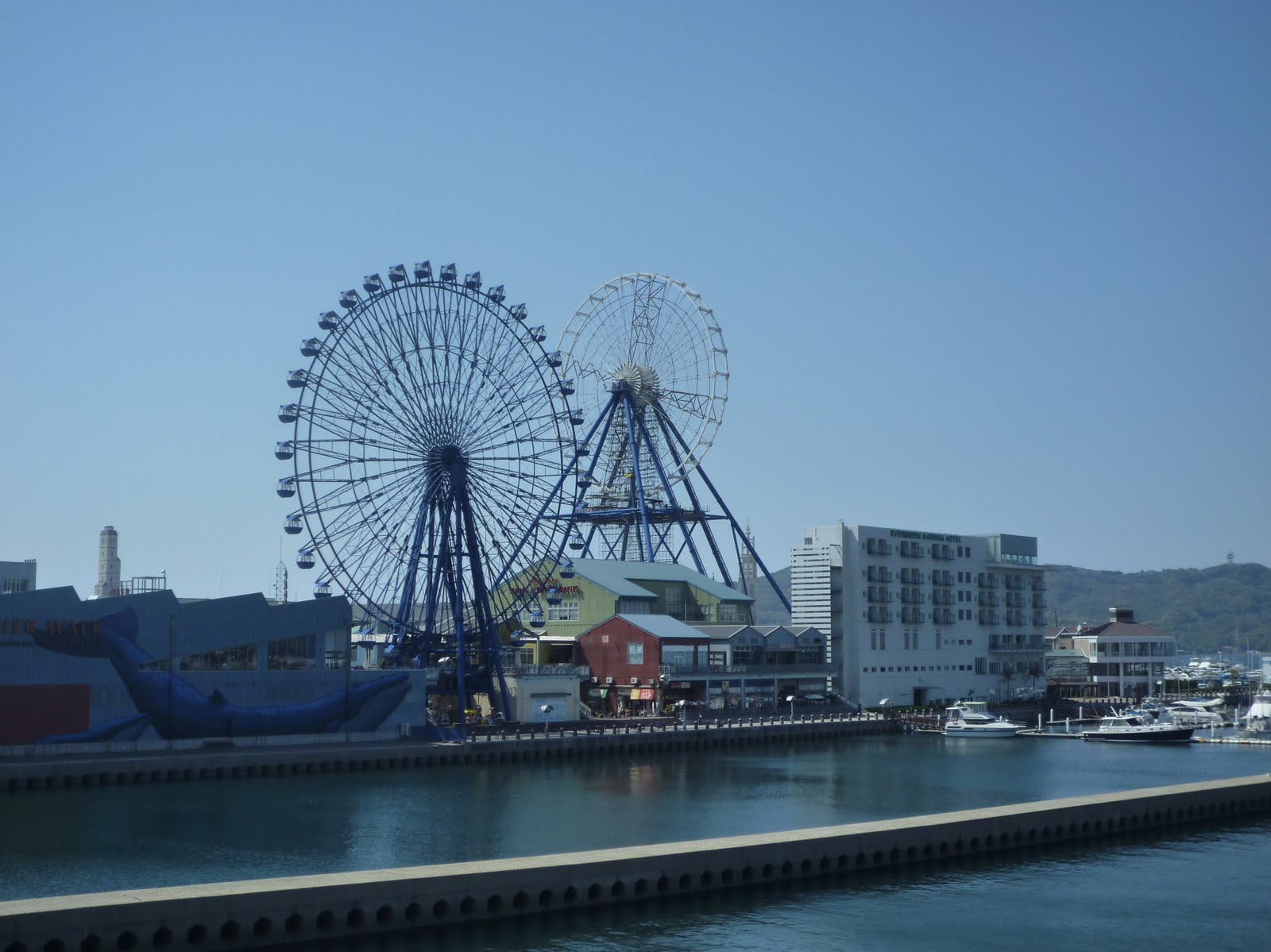
The thing sat silently for at least a year after its closure, but last summer work commenced on dismantling it and by now it looks close to half finished. It has been sold to a Taiwanese investor and, once they have re-constructed it there, that country will have a Ferris wheel larger than any in all of Japan (and the 9th largest in the world).
Its kind of a sad story. This thing was only 8 years old when it closed - that is barely more than half the life expectancy of a chihuahua. Its entire existence from birth to death fit neatly within the confines of the fledgling 21st century, which must be a first for a structure of this magnitude.
Workers were busy at work taking the thing down piece by piece as we visited. It is a massive operation, it looks just as difficult as it must have been to build it in the first place.

Nearby its smaller twin rotates in somber silence, mourning the loss of its big brother:Ena and I had ice cream under the little one (literally):
We had to wonder if this one's days aren't numbered also. In the 15 minutes we were there not a single customer appeared. One by one the lonely little gondolas arced skyward, empty. It was a Monday though and the mall wasn't too busy, perhaps on the weekend it'll get more business. We thought of going up, but it seemed like it would have been a sorry substitute for the big one we sorely wished we had ridden when we had the chance. And the 500 yen price for what looked like a 3 minute or so ride seemed a bit steep.

Anyway, that is the abbreviated story of Sky Dream Fukuoka. Its fall from grace is no better exemplified than this photo from Fukuoka's official tourist website which has completely airbrushed it out of existence:
Like Trotsky, it was never there. Just a figment of our imaginations.

Postscript July 8, 2011

Yesterday I turned on the 9 o'clock NHK national news and their lead story was about this very Ferris wheel. The remainder of it collapsed suddenly while the disassembly work was underway. 2 cranes went down with it, and together they flattened a number of cars and did some damage to the building.

Pictures of the damage and story (in Japanese) are available here.

Related Posts:

- Kyudai Hakozaki: The Elegant Decay of a Dying Campus
- Fukuoka Airport and Shime Coal Mine
- Urban Ghost Town: The Bewitching Ugliness of Chiyomachi Nichome
- Shoutengai and Kashii: The Bulldozer Comes to Higashi Ku

Tuesday, February 15, 2011

Ostentation the Fukuoka Higashi Ku Way

Ladies and Gentleman, I present to you the latest work in the ouevre of Fukuoka's ultra chic condominium developers.

This is a curious creature. It has been under scaffolding for several months now and only recently has its true form been revealed to the world. I ride past it on Route 3 every now and then.

The reason I am posting about it is the building designer's odd choice to incorporate this architectural feature into his or her work:
That is a two and a half story high marble clad colonnaded entrance way.

I think pretentious flourishes like this are fine if you are designing, say, the Vatican. But I have to seriously question whether or not the designer of the above edifice ever actually visited the property upon which this innovative use of white marble (-ish) cladding was going to be installed before drawing up the building plans.

You'll notice that directly in front of this massive entrance there is a concrete and metal wall that defines the border of a parking lot which is unrelated to the building. The building is completely inaccessible from the direction in which this entrance faces. A quick look at the alley which will one day be the only way of accessing this massive thing reveals that the clearance between the two is about 10 feet:
I think what we have here is either a failure to communicate or just some sort of massive failure in the way in which building designers are being educated about balance and aesthetics.

It seems inconceivable to me that anyone could have looked at this building site before construction began and said "Hey, this spot here would be perfect for a two and a half story white marble clad colonnaded entrance. It will really impress the people parking their cars in the parking lot for the discount store in front of it."

And yet here it is.

There is a lot I really don't understand about the Japanese housing market. I am assuming that this ridiculous entrance added cost to the building, which will ultimately be passed on to the people who end up purchasing condos in it. Yet those people will be completely incapable of viewing this imposing entrance because the only way of accessing it is from a side alley in which it is barely noticeable.

Perhaps not having to look at it will be worth the extra cost, I don't know.

I also have to question the logic of building luxury condos in an area that looks like this:
The building (in the centre of the above photo) is surrounded on all sides by warehouses, factories and parking lots. Not a tree in sight. Its a big mystery. These condos will be expensive. People with money can afford not to live in miserable, ugly areas like this. Yet luxury condo developers build them here nonetheless.

Yet another layer of Fukuoka Higashi Ku's mysterious nature unveiled.

Wednesday, September 22, 2010

Fukuoka Airport and Shime Coal Mine: An Odd Combination, But That is Where I Went Today

I had to bike out to Fukuoka Airport today to renew my visa. I don't really like heading to the airport because its a really unpleasant ride mostly through an industrial area. The only interesting thing brightening the journey is the tasteful artwork to be found in a Pachinko Parlour parking lot:
I actually like Fukuoka airport. Its close to downtown, easily accessible by subway (less than 10 minutes to the heart of the city) and....well other than that its just a normal airport. Which is fine.

Up until about a year ago the newest public works boondoggle-in-the-making was an entirely new Fukuoka airport to be built on an artificially constructed island at an estimated cost of 920 billion yen (about 9 billion US dollars). Thankfully the governor said "no", which made me quite happy. These artificial island airports are such a waste of money and resources. Where we used to live in the Kansai area what can only be called idiotic decision making (particularly by the Kobe city government) led to two of these monstrosities (KIX and Kobe) being built right next to each other even though there was already an airport (Itami) servicing the region. The struggles of these new airports have been news fodder for some time now. Both Osaka and Kobe's city governments are massively in debt and they have these airports to thank for it. Joining in on the idiotic, unnecessary airport building boom was rural Ibaraki, which just opened its own finance-destroying airport much to the amusement of the mass media in March.

Anyway, enough about that. The one thing I find amusing about Fukouka's airport actually isn't in the airport itself, its what is across the street when you leave the front door:
Welcome to Fukuoka! Land of....ugly billboards. So, you know....come to Fukuoka...if you like billboards and stuff. Cuz we got lots of them.

These things are visible from miles away at night, when we take a bus out of town on the return trip I always look for these signs because they are the only Fukuoka landmark visible from the highway (which doesn't run anywhere near them) that is instantly recognizable. If you look closely, some of these are actually built directly over people's homes.

After finishing my business at the airport I decided to head over to nearby Shime town, which is only about 20 minutes by bike away. Shime is a former coal mining town whose mines shut down a long time ago. Last December the remnants of the Shime coal mine were declared an important cultural property by the central government. This is part of a new trend to recognize and protect former industrial sites for posterity's sake, NHK even did a show about it (not just about Shime, but the mine was included in one segment). I just had to go check it out for myself.

The road from the airport to Shime, I have to say, is not an attractive one. Especially on a rainy day, this guy provided the only color:
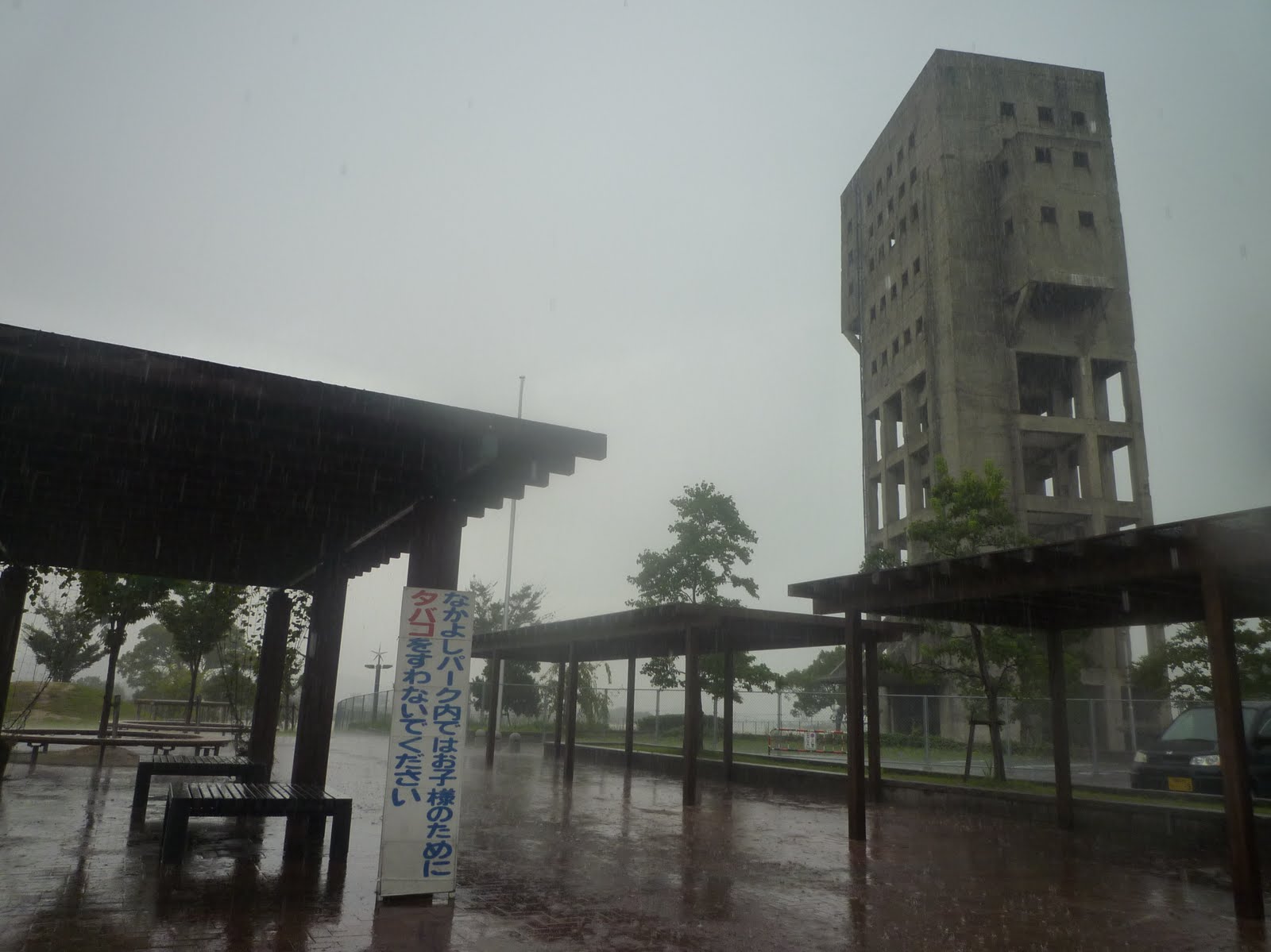
Anyway, after a few minutes of pedaling I arrived at Shime. Finding the coal mine wasn't hard as the shaft tower looms over the entire town and is easily visible in the distance:
The Shime mine began operations in the late 19th century, though the above structure (which is really all that is left above ground) was built during the war when the mine was used to supply coal to the Japanese Navy. It is a well-documented fact that a lot of coal mines in Fukuoka employed Allied POWs during the war in some really atrocious conditions. None of the signs which gave the building's history gave any hint of whether that was the case at Shime mine as well, though the time of its construction (1943) and its use by the Navy make me suspect it may have been.

At any rate, I have to admit that the building has an odd charm about it. Something about its odd shape, it looks different from different angles:

The mine was closed in 1964 and the structure sat abandoned until recently people became interested in preserving it as a form of cultural property. As you can see the concrete is in pretty rough shape:
While I found the building itself to be fairly interesting, the overall experience of going there was a bit of a let-down. While the structure itself has been barred up since it was closed, up until some time in the recent past it had been possible to walk right up to the building. There is a landscaped path that leads right next to it. Unfortunately they recently surrounded the thing with a tall chain-link fence that prevents anyone from getting within about 50 metres of it. The fence cuts across the path that used to lead right up to it:
There wasn't anyone around and I couldn't find out why they had done this, the signs just say "Entry prohibited". There may have been some valid safety concerns involved here, but closing it off like this really takes a lot out of the experience.

Actually the surrounding area isn't particularly nice either. They've built a giant public recreation hall right next to it and a park that has a few useless structures that do nothing to protect passing bloggers from the rain as I discovered during a sudden downpour while I was there:
Fencing things off, building parks and recreation halls is OK, but.....I think what needs pointing out is that - basically - this mine shaft is an ugly, ugly piece of concrete shit. The only thing that makes it interesting is its kind of brooding, derelict-looking state that can really make people's imaginations work. If you fence it off and surround it with the same sterile old shlocky municipal park-type crap with a big ugly recreation centre and huge parking lot right next to it, then you rob it of even that. I'm certainly not saying they should have just left it to rot, but there must have been a better way to do this.

Hmmm...on second thought maybe they should have left it to rot. Beautiful neighborhoods lined with lovely old wooden machiya getting bulldozed across the country and THIS is what they decide to invest money in protecting as important cultural property? Ah, screw it, I'll never understand this country.

Anyway, with the help of a cropping function I can still capture some of its brooding dereliction:

The entrance to the mine itself is nearby, also fenced off:
The town of Shime, once you get off the awful main road, isn't too bad. They seem to have had a lot of red bricks brought in at some time as some of the side streets are full of lovely walls made of them:
The tower looms over them:
Related Posts:

- Urban Ghost Town: The Bewitching Ugliness of Chiyomachi Nichome
- Shoutengai and Kashii: The Bulldozer Comes to Higashi Ku
- Kyudai Hakozaki: The Elegant Decay of a Dying Campus

Postscript - April 8, 2011


In the first few months since I put this post up it got a little over a 100 pageviews total. Then one day last week it suddenly got almost 2,000 in a single day.

Enter the Anti-Zombie Fortress meme. Apparently somebody noticed that the Shime coal mine would make a perfect anti-zombie fortress and the whole internet took notice of this bizarre fact and everyone suddenly wanted to know everything they could about the previously-obscure Shime coal mine. This post of mine and this one at Abandoned Kansai seem to be the only English blog entries out there detailing the mine, hence the surge of traffic.

Anyway, anyone out there looking to play with the Anti-Zombie fortress thing, I hereby give you permission and encourage you to use the photos on this post for whatever creative zombie related endeavours you may have, assuming this thing hasn't completely played itself out yet, which it might well have.

Sunday, September 19, 2010

Urban Ghost Town: The Bewitching Ugliness of Chiyomachi Nichome

When I ride my bike downtown I take a route that passes by the Fukuoka prefectural government’s capital building. It is a utilitarian, ugly grey edifice that isn’t worth photographing in its own right (hence the lack of photos here) but it does have the benefit of an avenue lined with lovely, mature camphor trees running in front of it which makes for a much more pleasant cycling experience than the smog-filled, treeless abomination that is route 3.

On passing the government buildings, the scenery abruptly changes. The interest of city planners in beautifying the area only seems to have extended as far as the line of site from the governor’s office reached. At that point we return to the usual indifferently laid out roadway that characterizes most of Fukuoka’s (and indeed any Japanese city’s) city-scape. Mature camphor trees turn to stunted, miserable looking deciduous trees whose limbs are regularly stripped of all greenery by city workers and the wide, tiled sidewalk turns narrow and bumpy.

At this point we have entered the strange nether land in the urban fabric of Fukuoka that is Chiyomachi Ni-chome.

Chiyomachi Ni-Chome (for the sake of brevity, “Chiyomachi”, though in actual fact I’m mainly talking about only the Ni-chome part of Chiyomachi) is perhaps one of the most miserable looking neighborhoods in Fukuoka. It exhibits layer upon layer of Japanese architectural and city-planning history that coalesce into an economically unviable, depressingly ugly mess of a neighborhood whose existence is pretty much ignored by everyone. In light of my recent fascination with the crumbling, desolate side of Japan as exhibited on this blog (like here and here) I just had to explore the area with my camera.

When one approaches Chiyomachi on just about any side on one of the several main roads that surround and bisect it, the buildings facing the street are the usual assortment of ghastly apartment buildings that developers have inflicted on every corner of the archipelago in recent years:

These buildings form a kind of wall facing out onto the main roads. One could pass through Chiyomachi on those roads and think the neighborhood was nothing but giant ugly apartment blocks. But hidden behind these apartment blocks on the back streets are the remnants of the townhouses and shoutengai of old Chiyomachi.

Proceeding down the road from the government buildings one gets a rare peak at this old world in an odd building whose façade is barely visible in a break between the high-rise edifices of the modern apartment and office buildings. It is a building that I’m sure everyone who has ever ridden a bike down this road will instantly recognize as it is the sort of thing that you can’t miss noticing. Those who zip by in cars probably won’t as it would go by in a flash. How the building is still standing is a mystery:The sight of this place is what first interested me in Chiyomachi. I’ve been watching it slowly crumbling bit by bit every week for the longest time. The roof finally caved in a few weeks ago and I thought I had better take some pictures of it quickly before it completely falls apart:I really have no idea why this thing has been allowed to slowly collapse in on itself for this long. In the countryside it isn’t unusual to find abandoned buildings slowly deteriorating, but this is in the middle of the city. The street is partially blocked by debris that has fallen off, with red pylons marking off the danger area:Even the scaffolding erected to hold it up looks ancient and like it might fall over with the building:

This is actually pretty much the typical fate of old townhouses like this, albeit most get pulled down before they reach this level of deterioration. Even in the midst of its decay and the patchwork of add-ons like the sheet metal siding you can see that in its prime it must have been quite an attractive wood building owned by some merchant or artisan in the old town. Chiyomachi was once dominated by buildings like this, as is evidenced by old pictures of the area, but they are a dying breed.

Actually, wood townhouses (“machiya”) like these have had a really hard time in Japan in recent decades. Up until about 40 years ago Kyoto – the cultural and traditional capital of Japan - had city streets which were lined by lovely rows of such machiya, giving the city a charming, traditional feel. Or at least so I’m told. By the time I made my first trip to Kyoto in 1999 most of those had been torn down and replaced by a generation of architecture that strictly followed the aesthetic demands of the “brutalist ugly plastic and concrete shit” school. A stake had been driven through the old city’s heart and it has never really recovered, a fact lamented by pretty much every western writer with an artistic bent who has visited Kyoto since the 1970s. In the past decade though the trend there has thankfully reversed itself and these lovely old machiya, once considered passé, are now back in vogue and efforts to preserve those that remain are helped by the fact that they command a price premium on the real estate market. They are, after all, quite attractive when well maintained as this one in Chiyomachi attests to:

This refreshing new trend in Kyoto unfortunately hasn’t washed up on Fukuoka’s shores yet and the rule here seems to be if you want to sell a piece of property with a machiya on it you are better off demolishing the machiya first and just selling the land, as it is worth more without it than with. As a result, most of the ones left are just waiting to be torn down when their current occupants, mostly old pensioners, pass away and the land moves on to other hands.

Very few attractive machiya exist in Chiyomachi these days, of the few that remain most have had plastic, concrete or metal facades added over the years that have robbed them of their traditional, wooden charm. Nonetheless, in the back streets you can see the struggling remnants of the old neighborhood somehow still existing in the shadows of the high rises that now surround them. Strolling the streets one is confronted by the obvious fact that this neighborhood has no more energy left in it. While most of the buildings are still occupied, not a soul stirs on what once upon a time must have been a bustling shopping street. All the shops now sit shuttered on a sunny Saturday afternoon:

Other houses sit abandoned, though not quite as near their ultimate fate as the one above:
A few potted plants at least give these places some vibrancy, indicating that people actually live here and care enough to water them:
Around the corner, more boarded up shops sit empty, no more customers to darken their doorways:
The look of decay on some corners resemble the type of thing you see in pictures of shanty towns in the less economically endowed parts of the world, though at least the places look lived in:
Back on the main road, one sees the bizarre results of trying to squeeze a 5 floor modern apartment building onto a parcel of land originally designed to hold a single machiya:

Across one of the major roads, a slightly more “alive” part of Chiyomachi boasts an interesting building still in business. This is a public bath, a dying breed in modern Japan where everyone has their own bath to use. In the old days though these were a mainstay of every neighborhood, just like barber shops and grocery stores. The door on the left leads to the women’s bath, the one on the right to the men’s.

Here is another well-preserved machiya. Unfortunately they lose a lot of their charm when surrounded by asphalt, ugly high-rises and power lines as this one is:
This side also boasts another struggling form of business that is dying out across the country: the old mom and pop style general store:
The sign says it sells “soap, cleaning goods, toothpaste and daily use goods” though one suspects that the cigarette machine provides its main source of income these days.

Another block reveals another era of Japanese urban development. Sometime in the 1970s (judging from the building style) a large part of Chiyomachi was replaced by some large scale apartment blocks. These are a bit different from the ones that front the major streets in that they take up the entire blocks on which they sit, meaning that all of the old town where these ones are was completely obliterated at the time of their construction.

The apartments are ugly and drab, but their most interesting feature are the storefronts that were built around them to front onto the sidewalks:

These have the look of strip malls, yet unlike most big developments these weren’t filled with big chain stores. Rather the little stores and restaurants of the old neighborhood seem to have moved in. It creates a strange contrast. The building obviously was a major undertaking which required a huge amount of financing to build. Yet the shops that occupy it are more or less the same kind of haphazardly organized places on sees in the run-down old buildings on shoutengai like those in Kashii. So you’ve got places like this vegetable shop with a mix-matched variety of tarps and empty boxes spilling out over the sidewalk and even onto the street:
The fact that it is in a big, expensive building hasn’t really done much to prevent this shoutengai from meeting the fate of so many others around Japan and large stretches of shops are to be found shuttered:Anyway, that is Chiyomachi Ni-chome. Only a few blocks away from Hakata station – the busiest piece of real estate in Kyushu (home to 13 million people) and yet it looks like the land that time forgot. I may be the first person ever to have bothered to write about it in English. A google search turns up precious little on the neighborhood. Even a Japanese language web search doesn’t turn up much. Its Japanese Wikipedia page just gives you some of the dry facts (date of foundation, population, etc) but tells you nothing of substance about it. Most of the other Japanese sites aren’t about Chiyomachi per se but sites dedicated to other things with which Chiyomachi happened to be connected, like Fukuoka’s old streetcar line (which used to run through Chiyomachi before the subway replaced it). In a few years the remaining houses will probably be cleared away and the whole neighborhood turned into a pachinko parlor parking lot or something. Kind of sad, but what are you going to do?